WordPress Autopublish Integrations for SEO: 2026 Guide
Explore how WordPress autopublish integrations for SEO allow marketers to scale content production, maintain quality, and free up time for strategic work...

'''
WordPress Autopublish Integrations for SEO: A Practical Guide for 2026
Thinking that WordPress autopublishing is a "set it and forget it" tool is like thinking a Formula 1 car drives itself. Handled by an amateur, it’s a fast way to crash. But in the hands of a skilled driver—the strategist—it’s an engine for winning. The goal isn’t to remove the human, but to give them a machine that executes their strategy at a scale impossible to achieve manually.
WordPress autopublish integrations for SEO are tools that automatically publish content from a third-party platform directly to your WordPress site. Their primary purpose is to scale content production for organic traffic growth by connecting AI content generators or programmatic SEO platforms to your blog. This eliminates manual uploads, ensures consistent publishing schedules, handles on-page SEO elements like titles and meta descriptions, and allows marketers to focus on strategy instead of tedious, repetitive content management tasks. Over 2,500 sites have already been connected using these modern systems.
What is WordPress Autopublishing for SEO, Really?
At its core, autopublishing is about creating a content supply chain. Instead of manually crafting, formatting, optimizing, and uploading every single blog post, you build a system that handles the logistical heavy lifting. This transforms the role of an SEO or content manager from a content producer into a content architect. You design the blueprint; the machine handles the construction.
Beyond Just "Hitting Publish"
True wordpress autopublish integrations for SEO do more than just drop a block of text into your CMS. A robust integration handles the full on-page SEO checklist. This includes:
- SEO Titles & Meta Descriptions: Automatically populated based on the target keyword.
- URL Slugs: Clean, keyword-rich slugs generated for every post.
- Categories & Tags: Assigning posts to the correct taxonomies to structure your site.
- Featured Images & Alt Text: Setting a featured image and ensuring it has optimized alt text.
- Internal Linking: Placing contextual links to other relevant articles on your site, a service we also manage for clients.
Who Is This For?
This technology is not just for massive enterprises. The primary users are often lean, growth-focused teams:
- Marketing Agencies: Managing content for dozens of clients becomes streamlined, allowing for better results and higher margins.
- E-commerce Businesses: Creating thousands of optimized pages for long-tail product or category searches to capture purchase-intent traffic.
- Startups and SMBs: Competing with established players by producing content at a velocity that would otherwise require a full-time content team. Many of the 27,000+ startup founders using these tools fit this mold.
- Solopreneurs: Automating a core part of their business to focus on product development and customer service.
The Core Benefits of Auto-Publishing for SEO
Why restructure your workflow around automation? Because the competitive advantages are no longer theoretical. For clients like Wolverine Assemblies, the ability to scale specialized content is a significant advantage.
Achieving Unprecedented Scale
The most obvious benefit is the sheer volume. A human can write, optimize, and publish maybe one or two high-quality articles a day. An automated system can publish hundreds. We assist clients by creating daily articles, but with automation, the ceiling is much higher. This allows you to target thousands of keywords, blanketing your niche with helpful content and establishing topical authority in weeks, not years.
Ironclad Publishing Consistency
Search engines reward consistency. A steady drumbeat of new content signals that your site is active and relevant. Autopublishing tools let you schedule content to be released at optimal times, maintaining a perfectly consistent publishing cadence without ever needing to log in. This "always-on" approach builds ranking momentum over time. A common goal is to publish articles of 2,000 words per blog post on average to provide substantial value.
Reclaiming Your Time for Strategy
How much time does your team spend on the mechanics of publishing? Copy-pasting from Google Docs, uploading images, checking SEO plugin settings—it all adds up. Automating these tasks frees up dozens of hours per month. This is time that can be reinvested into higher-value activities: deeper keyword research, building partnerships, analyzing performance data, and refining your overall SEO strategy.
The Autopublishing Workflow

A successful automated content engine isn't a black box; it's a well-defined process. While specific tools vary, the workflow generally follows a clear sequence:
- Strategic Input: It begins with human strategy. You provide the system with a list of keywords, article briefs, or topic clusters. This is the critical guidance that directs the automation.
- AI Content Generation: The platform uses advanced AI models to generate a draft based on your input. This draft is often structured with headings, lists, and paragraphs from the outset.
- SEO Optimization Layer: The system then optimizes this draft. It refines the title, writes a meta description, adds internal links, and ensures the content aligns with SEO best practices.
- Scheduled Push to WordPress: Once optimized, the article is sent to your WordPress site via an integration (like the REST API). It can be published immediately or, more commonly, added as a scheduled draft to go live at a future date.
- Post-Publish Monitoring: The job isn't done at publication. The final step is tracking the performance of the automated content in Google Analytics and your rank tracker of choice, using the data to refine future keyword inputs.
Integrating WordPress with Autopublishing Platforms
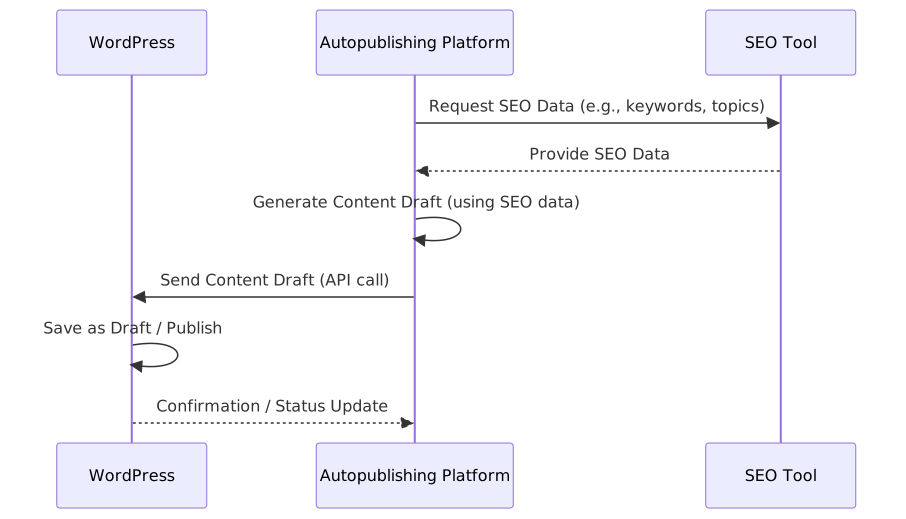
Connecting your content engine to your WordPress site is the crucial final step. There are two primary methods for achieving this, each with its own set of trade-offs.
Direct REST API Integration
The WordPress REST API is a powerful interface that allows applications to "talk" to your WordPress site programmatically. SaaS platforms like Rank My Website use this method because it’s robust, secure, and highly flexible. It allows for the creation of posts with full control over every detail—content, titles, custom fields, SEO metadata, and more. According to the official wordpress handbook, the REST API provides a standardized way to interact with site data.
Dedicated WordPress Plugins
The alternative is a dedicated plugin installed on your WordPress site. The third-party platform sends content to the plugin, which then creates the post. This can be simpler to set up initially ("setup in 2 minutes" is a common claim), but it adds another piece of software to maintain and update on your site. It can also be less flexible than a direct API integration, potentially limiting the types of content or on-page elements you can control.
Compatibility with Yoast, Rank Math, and Others
Any credible autopublishing integration must work with the dominant SEO plugins. More than 7 million websites use yoast seo, and Rank Math is also incredibly popular. A good integration won't just create a post; it will populate the specific fields used by these plugins, such as the focus keyphrase, meta description, and social sharing titles, ensuring your technical SEO foundation is solid.
An autopublishing tool doesn't replace your SEO plugin. It works through your SEO plugin, using it as the vehicle to implement on-page SEO at scale.
Choosing the Right Autopublishing Integration

Not all integrations are created equal. Choosing the right one depends on your technical comfort, budget, and long-term goals.
SaaS Platforms vs. Custom Scripts
For most businesses, a fully-managed SaaS platform is the superior choice. Building your own scripts is a significant technical undertaking that requires ongoing maintenance.
| Feature | SaaS Platform (e.g., Rank My Website) | Custom-Built Script |
|---|---|---|
| Setup | Simple, often wizard-based | Complex, requires development expertise |
| Features | Rich features (SEO, images, scheduling) | Limited to what you can code |
| Maintenance | Handled by the provider | Your responsibility; breaks with WP updates |
| Cost | Monthly/annual subscription | High upfront development cost + maintenance |
| Support | Dedicated support team | You are the support team |
Essential Features for SEO Success
When evaluating platforms, look beyond the simple "publish" button. Key features include:
- Image Handling: Can it add featured images, insert images into the content, and set alt text?
- AI-Powered Internal Linking: Does it intelligently link to your existing content to build a strong site structure?
- SEO Plugin Sync: Does it fully integrate with Yoast, Rank Math, or your plugin of choice?
- Content Originality: Does it have measures to ensure the AI-generated content is unique and passes plagiarism checks?
The Hidden Risks of Automated Content (and How to Avoid Them)
With great power comes great responsibility. Mindlessly flooding your site with low-quality AI content is a fast track to an algorithmic penalty and a destroyed brand reputation.
The Quality Control Mandate
Automation is for execution, not for strategy or quality assurance. You must have a human-in-the-loop process. This means reviewing batches of content before they are scheduled, spot-checking published articles, and using performance data to identify and improve or remove underperforming content. Treat the AI as a very fast, very capable junior writer—it still needs an editor.
The moment you stop reading the content your machine publishes is the moment you start gambling with your brand and your rankings.
Navigating AI Detection and Search Engine Policies
Google's stance, as clarified in their guidance on ai-generated content, is that high-quality content is rewarded, regardless of how it's produced. Their focus is on penalizing low-quality, spammy content intended to manipulate rankings. The risk isn't the AI; it's the quality. If your autopublished content is generic, unhelpful, and created solely for search engines, it will fail. If it’s genuinely useful and well-structured, it aligns with Google’s goals.
Ethical Guardrails for Scaled Publishing
Just because you can publish 500 articles about a topic doesn't always mean you should. As this technology becomes more widespread, there are important ethical questions to consider. Are you adding value to the internet, or just noise? Ethical marketing practices suggest focusing on user benefit, not just automated output. A good strategy focuses on comprehensively covering a topic to serve user intent, not just to rank for every possible keyword variation.
Measuring the ROI of Your Auto-Publishing Strategy
How do you prove that your investment in automation is paying off? You need a clear measurement framework that connects content output to business results.
Tracking Keyword Rankings and Organic Traffic
The most direct metrics are found in your SEO tools and Google Analytics. You should be tracking:
- Impressions and Clicks (GSC): Are the new pages being seen and clicked on in search results?
- Keyword Movement: Are you seeing a steady increase in the number of keywords you rank for?
- Organic Traffic Growth: Is the overall traffic to your blog or
/blog/subdirectory increasing month-over-month?
Connecting Content to Conversions
Traffic is good, but revenue is better. Set up goals in Google Analytics to track how many visitors from your automated content go on to perform a valuable action, such as signing up for a newsletter, requesting a demo, or making a purchase. This allows you to tie the cost of your content automation platform directly to the revenue it generates, calculating a clear ROI.
Frequently Asked Questions
Can Google penalize you for using autopublishing tools?
Google does not penalize sites for using AI or automation, but for producing low-quality, spammy content. If you use autopublishing to scale high-quality, helpful, and original content, it is perfectly safe. If you use it to generate unedited, generic spam, you risk a penalty.How much content should I autopublish?
This depends on your niche, resources, and goals. The focus should be on quality and relevance over pure quantity. A good starting point is to identify a topic cluster and aim to build comprehensive authority there, which might mean 20-50 articles, rather than publishing 5 articles on 10 different topics. Consistency is more important than volume.Do I still need to know SEO if I use an autopublishing tool?
Yes, absolutely. In fact, your strategic SEO knowledge becomes even more valuable. The tool handles the execution, but you are responsible for the strategy—keyword research, topic selection, competitive analysis, and performance review. The tool is an amplifier for your expertise, not a replacement for it.What's the difference between autopublishing and programmatic SEO?
Programmatic SEO is a strategy that involves creating pages at scale by programmatically combining data with templates (e.g., "Best hotels in [City]"). Autopublishing is the mechanism used to publish content to a CMS like WordPress. You can use an autopublishing tool to execute a programmatic SEO strategy, but you can also use it to publish individual AI-generated articles.Investing in WordPress autopublish integrations for SEO is one of the single most effective ways to scale your organic growth in 2026. It allows you to build topical authority, save hundreds of hours, and focus your team on the strategic work that truly drives results. With over 500K+ articles already published through these systems, the proof is in the rankings. If you're ready to put your content strategy on autopilot (the right way), try building your website with our free trial and get 7 free articles. '''