Shopify Blog Automation: The Silent Competitor You Need to Beat
Transform your Shopify store with AI blog automation for ecommerce SEO. Discover how it drives organic traffic, reduces ad costs, and scales content...
Shopify Blog Automation for Ecommerce SEO: Your Autopilot for Organic Traffic in 2026
Your Shopify store has a silent competitor who works 24/7, never asks for a raise, and publishes perfectly optimized content every single day. That competitor is automation. If you think a blog is a "nice to have" that you'll get to eventually, you're already falling behind. The manual content grind is a losing game for busy ecommerce entrepreneurs.
Shopify blog automation for ecommerce SEO uses AI-powered tools to perform keyword research, generate high-quality articles, optimize for search engines, and publish content directly to your store. This process transforms content creation from a manual slog—often taking 5+ hours per article—to a streamlined, ten-minute task. It allows store owners to consistently build organic traffic and reduce reliance on expensive paid ads without hiring a dedicated content team or sacrificing quality.
Why Your Shopify Store Is Invisible Without a Blog
Many Shopify store owners focus entirely on product pages, collections, and paid ads. This makes sense; those are the money pages. But this approach leaves you vulnerable. You're constantly paying a toll to platforms like Google and Meta to acquire customers, and you have no long-term asset to show for it.
The Losing Battle Against Rising Ad Costs
According to data from Speero, customer acquisition costs have risen by 222% over the last decade. Every time a potential customer clicks your Google Shopping ad, you pay. When they see your ad on Instagram, you pay. This "renting" of traffic is a treadmill. An optimized blog, however, builds an owned audience. It turns your store into a destination and an authority, attracting customers through valuable content that ranks organically, free of charge, for years.
The "5+ Hours Per Article" Content Bottleneck
For a solo founder or small team, the content creation process is brutal. You have to research keywords, outline an article, write 2,000 words, find images, optimize it for SEO, and finally publish it. One competitor quotes this workflow at 5+ hours per article. If you do this once a week, you’ve lost half a workday. This is an unsustainable model, leading to burnt-out founders and abandoned blogs. It's the single biggest reason most Shopify stores fail at content marketing.
How AI-Powered Blog Automation Boosts Shopify SEO
This isn't about churning out soulless, robotic articles. It’s about building a strategic content engine that addresses real customer problems at scale. True shopify blog automation for ecommerce seo is a multi-faceted process that goes far beyond just writing.
From Keyword Discovery to Topic Authority
Modern automation platforms don't just guess what to write about. They perform data-driven keyword research, identifying what your potential customers are actually searching for. Then, they group these keywords into topic clusters. By systematically creating content for an entire cluster, you signal to Google that you're an authority on that subject, making it easier for all related articles to rank. At Rank My Website, our platform automates this entire discovery and clustering process, a service we've honed for clients across various industries, including B2B players like Wolverine Assemblies.
Generating Problem-Focused Content, Not Just Product Puff
Your customers aren't searching for your product's SKU. They're searching for solutions to their problems. A well-designed automation workflow excels at this.
"Say goodbye to spending 5+ hours per article – this workflow generates SEO-optimized content that addresses customer pain points, not just product features."
Instead of another post about your new widget's specs, you can automatically generate an article titled "5 Ways to Solve [Problem X]" where your widget is naturally presented as the best solution. This approach, validated by a 2022 Semrush study showing "how-to" guides and "listicles" are the most effective content types, builds trust and drives qualified traffic.
Built-in Technical SEO: Meta Tags, Alt Text, and Schema
Good SEO isn't just about the words on the page. It’s about the dozens of small technical details that search engines use to understand and rank your content. Automating your Shopify blog handles these tedious but critical tasks automatically:
- Meta Titles and Descriptions: Generates compelling, keyword-rich snippets for search results.
- Image Alt Text: Creates descriptive alt text for all images, improving accessibility and image search rankings.
- Internal Linking: Automatically adds links to other relevant products or articles on your site.
- Schema Markup: Implements structured data so Google can display rich results, like star ratings or FAQ snippets, directly in search.
The Shopify Blog Automation Workflow

What does this process look like in practice? While platforms differ, a best-in-class automated workflow generally follows these steps:
- Connect Your Store: You start by securely connecting your Shopify store to the automation platform via a native app or API key.
- Define Your Keywords: You provide a set of seed keywords related to your products, brand, and target audience. The platform's keyword research module then expands this into a full content strategy with hundreds of long-tail topics.
- Configure Content Settings: Set the tone of voice (e.g., expert, witty, formal), select the target audience, and establish a publishing cadence (e.g., one article every Tuesday). Many services, including our own at Rank My Website, can even deliver daily articles to maximize content velocity.
- AI Generation & Optimization: The platform’s AI drafts a full-length article based on a selected keyword. It structures the content with H1s and H2s, includes relevant information, and optimizes it based on SEO best practices.
- Human Review (Optional but Recommended): The drafted article is sent to you for a quick review. This is your chance to add a personal story, tweak a product recommendation, or inject brand-specific nuance. Most platforms reduce this to a 10-minute check.
- Autopilot Publishing: Once approved (or automatically after a set time), the platform publishes the article directly to your Shopify blog, complete with all SEO elements, images, and internal links.
- Performance Tracking: The system monitors the article's performance, tracking keyword rankings and organic traffic, providing clear data on your ROI.
Comparison of Leading Shopify Blog Automation Tools
Several tools offer AI-powered content for Shopify, but their capabilities and pricing models vary significantly. When choosing a solution, it's crucial to look beyond the AI writer and evaluate the entire end-to-end SEO workflow.
| Feature | Rank My Website | Bloggle | Egnition | SEO Automator App |
|---|---|---|---|---|
| Core Function | End-to-End SEO Automation | AI Blog Post Writer | Product-to-Blog AI | Basic SEO Meta Fields |
| Keyword Research | Automated, Cluster-Based | Manual Input Required | Based on Product Title | None |
| Direct Shopify Publishing | Yes, with scheduling | Yes | Yes | Yes |
| Technical SEO | Meta, Alt-Text, Schema, Links | Basic Meta & Alt | Basic Meta | Basic Meta |
| Human Review Step | Yes, integrated workflow | Yes | Minimal | N/A |
| Pricing Model | Tiered Subscription | Per-Article Credits | Tiered Subscription | One-time fee + usage |
| Best For | Scaling organic traffic | Quick, one-off articles | Content for product variants | Fixing tech SEO on pages |
The goal of blog automation isn't to fire your content team. It's to arm a single marketing manager with the output of a 10-person agency.
Integrating AI Writing Tools with Shopify
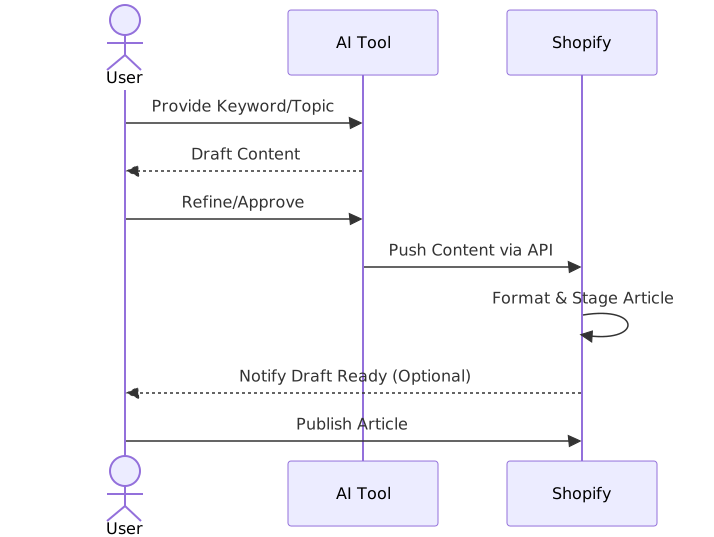
Connecting an AI tool to your store is the first step. Making it work as a cohesive part of your marketing strategy is where the real value lies. This involves choosing the right type of integration and establishing a clear editorial process.
Native Apps vs. External Platforms
Many tools are available directly in the Shopify App Store. These offer the benefit of a one-click install and deep integration. For example, apps like Egnition or Bloggle live entirely within your Shopify admin. This is convenient but can sometimes be limiting. External platforms like Rank My Website connect via an API but run on their own infrastructure, often providing more powerful features for keyword research and competitive analysis that aren't feasible within the confines of a simple app.
The Human-in-the-Loop: Editorial Oversight
A critical best practice is maintaining human oversight. Letting an AI publish directly to your site without review can lead to off-brand content or factual inaccuracies. The most successful ecommerce brands using automation implement a "human-in-the-loop" model. The AI does 90% of the work—the research, drafting, and optimization. A human spends 10% of the time providing the final polish, ensuring brand voice alignment and adding unique insights. This hybrid approach delivers both scale and quality, a core principle we build into our own platform to ensure content remains an asset, not a liability.
Measuring the ROI of Your Automated Content Engine
How do you know if your investment in Shopify blog automation is paying off? You must move beyond vanity metrics like page views and focus on data that ties directly to business outcomes. A recent study by Wolfgang Digital found that SEO drove 42% of a site's revenue, more than any other channel. Your automation tool should help you prove that impact.
Tracking Keyword Rankings and Organic Traffic
All credible automation platforms should include a dashboard to track your keyword rankings in Google. Are you moving from page 10 to page 1 for your target terms? The platform should also integrate with Google Analytics or offer its own traffic reporting. You need to see a clear, upward trend in organic (non-paid) sessions originating from your blog content.
From Traffic to Transactions: Conversion Goals
The ultimate measure of success for an ecommerce store is sales. Your blogging efforts must be tied to revenue. This can be measured in a few ways:
- Direct Conversions: A customer reads a blog post, clicks an embedded product link, and makes a purchase in the same session.
- Assisted Conversions: A customer discovers your brand through a blog post, leaves, and then comes back later through another channel (like a direct visit or a branded search) to buy something. Google Analytics' "Assisted Conversions" report is essential for tracking this.
- Lead Generation: For high-ticket items, the blog's goal may be to capture an email address for a newsletter or a consultation request.
Key Features to Look For in Shopify Blog Automation Tools
When evaluating different apps and platforms, focus on the features that drive real SEO results and streamline your workflow.
Topic Clustering & Keyword Research: The tool must help you plan what* to write about, not just write it.- Direct Shopify Integration: Avoid tools that require you to copy and paste. True automation means seamless publishing.
- Full SEO Optimization: It must handle meta tags, image alt text, internal linking, and schema markup automatically.
- Customizable Content Cadence: You should be able to set and forget your publishing schedule, whether it's weekly or daily.
- Human Review Workflow: Look for a tool that makes it easy to review and approve content before it goes live.
- Transparent Pricing: Be wary of confusing credit systems. Many popular apps start with a free plan available or low monthly fees like $19 / month or $12.75 / month, but the costs can escalate. A flat subscription is often more predictable. For example, Ahrefs' data on blogging frequency shows a strong correlation between publishing volume and traffic growth, so a plan that doesn't penalize you for publishing more is ideal.
Frequently Asked Questions
Can Google detect and penalize AI-generated content?
Google's official stance is that it rewards high-quality content, regardless of how it is produced. As long as the content is original, helpful, and not designed to manipulate search rankings, using AI is perfectly acceptable. The key is quality and value, not the tool used to create it.How long does it take to see SEO results from an automated blog?
SEO is a long-term strategy. While you can get a blog post written and published in under 10 minutes with automation, it can take 3-6 months to see significant traction in Google rankings and organic traffic, especially for a new site. The key is consistency, which automation makes achievable.Will blog automation create duplicate content?
No, reputable AI blog automation tools generate unique content for every article. They use sophisticated language models like GPT-4 to create original text from scratch based on the given keyword and topic. The content is not scraped or spun from other sources.Is Shopify blog automation expensive?
It can be, but it's almost always cheaper than the alternatives. Hiring a freelance writer can cost $200-$500 per article. A full-time content manager is a significant salary. Automation tools offer pricing from free plans to subscriptions that might cost $19 / month to a few hundred, providing the output of a much larger team for a fraction of the cost.Can I use this for a store in any niche?
Yes. The principles of SEO and problem-focused content apply to every niche, from fashion and beauty to industrial parts and B2B services. A good automation tool can research and write authoritatively on any topic once it is given the correct seed keywords and audience context.Ready to put your Shopify blog on autopilot and start building a real traffic-generating asset? Rank My Website generates SEO-optimized content from your keywords and publishes it directly to your site, with a full suite of on-page tools to help you achieve faster, more consistent rankings.