SEO for SaaS Companies: A Problem-First Content Strategy
Unlock organic growth for your SaaS company with a problem-first SEO strategy. Learn how to attract high-intent users, build authority, and convert leads effect
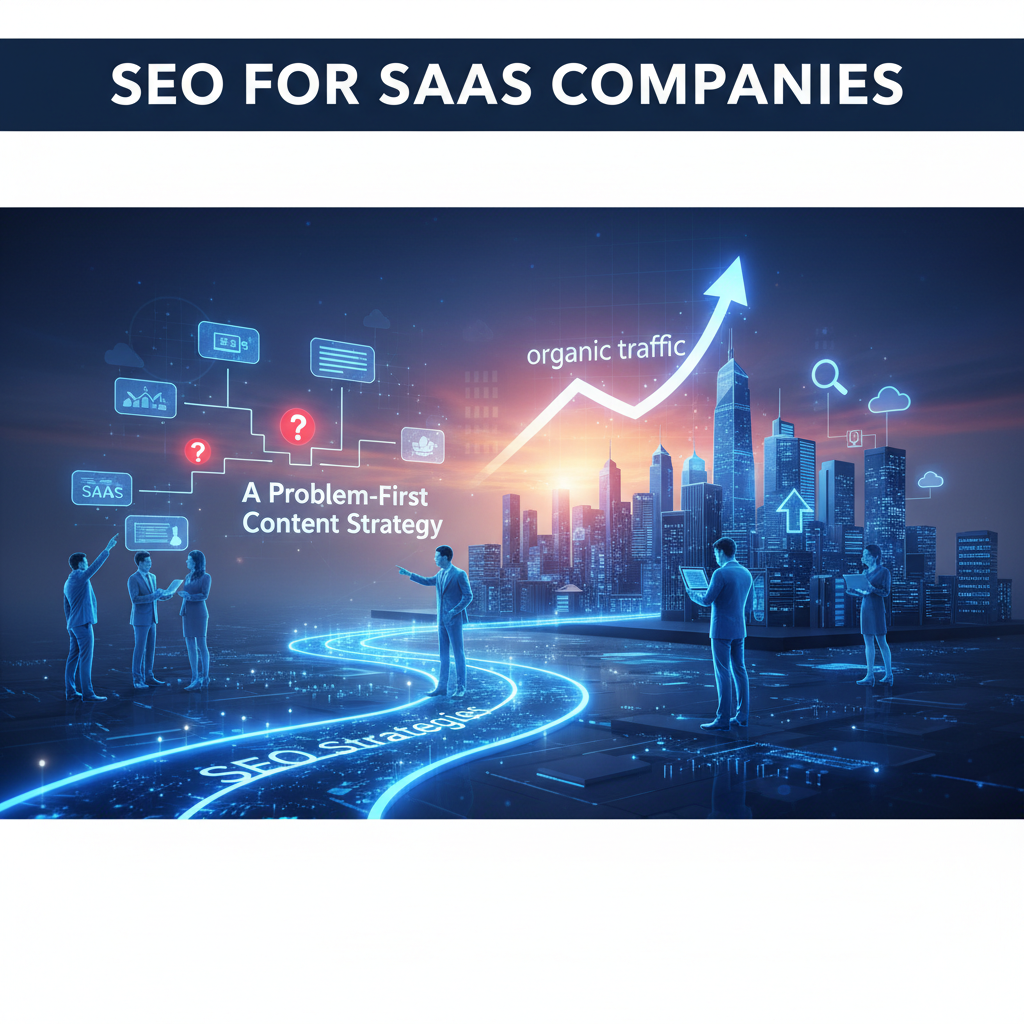
''' Is your SaaS marketing budget a black hole? You pour money into paid ads, sponsor newsletters, and attend conferences, yet your customer acquisition cost (CAC) keeps climbing. Most SaaS companies treat SEO as a side project, a technical checklist to be handed off to an intern. This is a critical mistake. Effective SEO for SaaS companies involves a full-funnel content strategy that targets user problems, not just software features. It means creating content for every stage of the buyer's journey—from high-level blog posts addressing pain points to detailed comparison pages for bottom-of-funnel users. Technical SEO and authority-building through strategic partnerships are also critical for driving qualified organic traffic.
Paid channels are a necessary part of a startup's growth, but they are rented land. The moment you stop paying, the leads dry up. Organic traffic from SEO is an owned asset; it’s a content engine that compounds over time, attracting high-intent users 24/7. While only about 3% of B2B SaaS website traffic converts on average, according to a 2023 report from HockeyStack, the quality of organic leads is often significantly higher than from outbound efforts.
Why Most SaaS SEO Fails
Many software companies get SEO wrong from the start. They target keywords that are either too broad (e.g., "project management") or too narrow and technical (e.g., "Gantt chart API integration"). The result is either traffic that doesn't convert or no traffic at all. The core issue is a misalignment between what the user is searching for and the content the company provides.
Three common failure points are:
- Chasing "vs." Keywords Too Early: Startups see competitors ranking for "[competitor] vs. [your brand]" and immediately try to build their own page. This only works if people are actually searching for your brand. Ahrefs shows zero search volume for your brand? Then that page is a waste of resources.
- Focusing Only on Bottom-Funnel Content: Companies obsess over their feature pages and pricing page optimization. These are important, but they only serve the 1-3% of your audience who are ready to buy right now. You ignore the 97% who are still trying to understand their problem.
- Ignoring Technical Debt: Your marketing site is built on the same complex JavaScript framework as your app. It looks slick, but Googlebot struggles to crawl and render it, leading to poor indexing and rankings. According to Google, Core Web Vitals are a direct ranking factor, and slow, complex sites almost always fail them.
A Better Framework: The Problem-First Content Strategy
Instead of shouting your features into the void, a successful SaaS SEO strategy starts by deeply understanding your customer's problems. It’s not about what your software does; it’s about what it solves. This requires a shift from a feature-led to a problem-led content model.
Step 1: Map Problems to Keywords
Your ideal customers aren't searching for "best Kanban board software." They're searching for "how to manage a remote team's workload" or "why do my projects always go over budget?" Your job is to connect their problem to your solution through content.
Use tools like Ahrefs, Semrush, or even just Google's "People Also Ask" section to find these problem-based queries. Group them into topics. For project management software, topics might include:
- Remote team collaboration
- Project budget tracking
- Client communication workflows
- Marketing campaign planning
Step 2: Build a Content Moat with Full-Funnel Content
Once you have your topics, you need to create content that serves users at every stage of their journey. This creates a "content moat" that makes your brand the go-to resource in your niche.
- Top of Funnel (ToFu): Problem Awareness. This is where you attract the largest audience. The goal is not to sell, but to educate and build trust. Content formats include blog posts, guides, and free templates. Example: A blog post titled "5 Telltale Signs Your Team Is Suffering from Project Overload." This is a perfect place to explore how using the right seo automation with ai can help teams scale their efforts.
- Middle of Funnel (MoFu): Solution Comparison. Users here know they have a problem and are now researching solutions. This is where you introduce your product as a viable option. Formats include comparison pages ("Asana vs. Trello vs. Monday"), detailed "how-to" guides using your product, and case studies. For instance, a guide on "How to Set Up a Marketing Calendar in [Your Product Name]" directly bridges the gap between their need and your feature set. You can use platforms that help with ai content for agencies to produce these assets at scale.
- Bottom of Funnel (BoFu): Purchase Decision. These users are ready to buy. Content here should remove any final barriers to conversion. Think detailed feature pages, pricing breakdowns, security documentation, and customer testimonials. This is where you link directly to your "Get a Demo" or "Sign Up" pages. Clarity and trust are paramount.
Step 3: Nail the Technical SEO Foundation
A beautiful website that Google can't read is useless. SaaS sites often have unique technical challenges that need addressing.
- JavaScript & Rendering: Many SaaS marketing sites are built with frameworks like React or Vue.js. While Google has gotten better at processing JavaScript, it’s not perfect. It is crucial to ensure your important content is rendered server-side or available in the initial HTML document. Test your pages with Google's own Mobile-Friendly Test to see what the crawler sees. For a deep dive, Google provides extensive documentation on how to fix JavaScript SEO issues.
- Site Speed: A slow website kills conversions. A 2018 Deloitte study found that even a 0.1-second improvement in site speed can boost conversion rates by 8%. For SaaS, this is critical. Compress images, minify CSS and JavaScript, and use a content delivery network (CDN) like Cloudflare to ensure your site is fast for users globally.
- Crawl Budget: For large SaaS sites with hundreds of feature pages, thousands of blog posts, and documentation, "crawl budget" can become an issue. Ensure you use a clear XML sitemap, a logical URL structure, and a
robots.txtfile to guide search engines to your most important pages and away from non-essential ones like internal search results.
Step 4: Earn Authority with Strategic Link Building
Content and technical SEO are only two legs of the stool. Authority, primarily built through backlinks from other reputable websites, is the third. For SaaS, the best links come from demonstrating expertise and value, not from spammy tactics.
- Integration Partnerships: Build "Works with [Your Product]" pages and co-market with your integration partners. Announce the partnership on your blog and have them do the same. This generates highly relevant backlinks and referral traffic.
- HARO (Help a Reporter Out): Journalists are constantly looking for expert quotes from tech leaders. Responding to relevant queries on HARO with genuine insights can land you quotes and links in major publications like Forbes, TechCrunch, and Fast Company.
- Original Research & Data: This is the most powerful link-building tactic. Package your proprietary user data (anonymously, of course) into a compelling industry report. For example, a project management tool could release a report on "The State of Remote Work Productivity in 2024." This creates a valuable asset that other blogs and news sites will link to as a primary source. While challenging, this is far more sustainable than questionable automated backlink strategies.
FAQ
How long does SEO take to work for a SaaS company?
For a new site, expect to see initial traction in 6 to 9 months. SEO is a long-term investment. The goal is to show consistent, incremental growth in organic traffic and keywords month over month. Competitive niches can take over a year to see significant results, but the compounding returns are worth the wait.
What are the most important SEO metrics for SaaS?
Beyond just organic traffic, focus on metrics that tie to business goals. Key metrics include: Demo Sign-ups from Organic, Trial Starts from Organic, Keyword Rankings for high-intent terms, Customer Lifetime Value (CLV) from the organic channel, and branded vs. non-branded search volume growth.
Should we target keywords with competitor names in them?
Yes, but only when you have some brand recognition yourself. Create "Alternative to [Competitor]" pages that are honest and helpful, not just attack pages. Acknowledge the competitor's strengths, then clearly articulate your differentiating features and who your product is a better fit for.
Do we need a blog for SaaS SEO?
Absolutely. A blog is the primary engine for your ToFu and MoFu content strategy. It's how you attract users who aren't yet aware of your product. Without a blog, you are only able to target a tiny fraction of your potential audience—the ones who are already searching for a software solution.
Is technical SEO more important for SaaS than other industries?
Arguably, yes. Because SaaS websites and the products themselves are often built with complex code, the potential for technical SEO issues is much higher. JavaScript rendering, subdomains for the app vs. the marketing site, and internationalization (hreflang) are common challenges that can seriously hinder SEO performance if not handled by an expert.
How much should a SaaS company budget for SEO?
This varies wildly based on size and goals. Early-stage startups might start with a freelance consultant for $2,000-$5,000/month. A growth-stage company might build an in-house team or hire an agency for $10,000-$50,000+/month. The key is to view it as an investment in an owned asset, not just a marketing expense.
How does seo automation fit into a SaaS strategy?
SEO automation tools like Rank My Website can dramatically speed up the content production and optimization process. They can help with keyword research, content brief generation, on-page SEO checks, and even publishing, allowing a small team to execute a large-scale content strategy that would otherwise require several full-time hires. '''