How to Use an AI Keyword Research Tool: A Masterclass
Ready to master SEO in 2026? This guide reveals how to use an AI keyword research tool to find untapped opportunities and dominate search rankings.

How to Use an AI Keyword Research Tool: A 2026 Masterclass
The world of search engine optimization (SEO) is in a constant state of flux, but the evolution we're witnessing in 2026 is nothing short of revolutionary. The days of manually sifting through spreadsheets and making educated guesses about keywords are rapidly coming to an end. Today, success in organic search is dictated not by who has the most keywords, but by who best understands the user intent behind them. This is where the ai keyword research tool emerges as the essential weapon in any serious digital marketer's arsenal. It represents a fundamental shift from keyword gathering to strategic insight generation. An advanced ai keyword research tool doesn't just tell you what people are searching for; it helps you understand why they are searching for it, what other questions they have, and where they are in their buying journey. By leveraging artificial intelligence, we can now uncover hidden opportunities, build undeniable topic authority, and create content that resonates with audiences on a much deeper level, leading to sustainable growth and a commanding presence in the search results.
This comprehensive guide will serve as your masterclass, walking you step-by-step through the process of harnessing the power of an ai keyword research tool. We’ll move beyond the basics of search volume and difficulty to explore the strategic application of AI-driven insights. You will learn how to define your core topics, generate massive lists of relevant queries, analyze them with a new layer of intelligence, and organize them into powerful topic clusters that Google loves. Forget the old, tedious methods; it's time to embrace a smarter, faster, and more effective approach to dominating the SERPs in 2026 and beyond.
Understanding the Evolution from Traditional to AI Keyword Research
For years, the standard approach to keyword research was a relatively straightforward, if laborious, process. It often began and ended with a tool like Google Keyword Planner. Marketers would input a "seed" keyword, receive a list of related terms with their average monthly search volumes and a vague competition score, and then build their content strategy around these isolated phrases. While groundbreaking at the time, this traditional model has significant limitations in today's sophisticated digital ecosystem. It provides a flat, one-dimensional view of a multi-dimensional search landscape. It often misses the vast ocean of long-tail keywords, fails to grasp the nuances of user intent, and offers little insight into the semantic context that now governs how search engines rank content. The result was often content that targeted a keyword but failed to answer the user's core question, leading to low engagement and poor rankings.
The paradigm shift came as search engines like Google grew smarter. They evolved from simple string-matching machines into complex understanding engines. Thanks to advancements like semantic search and natural language processing, search engines now focus on deciphering the intent behind a query, not just the words it contains. They understand that "how to fix a dripping tap" and "leaky faucet repair" are about the same problem. This is where the modern ai keyword research tool changes the game entirely. Instead of just fetching data, it performs complex analysis. It doesn't just look at individual keywords; it analyzes the entire search engine results page (SERP), understands the relationship between different queries, and identifies the underlying topics and subtopics that demonstrate true expertise. An effective ai keyword research tool allows you to see the search landscape as Google sees it: a web of interconnected concepts and user journeys, not just a list of phrases.
Step 1: Defining Your Core Seed Topics and Business Goals
Before you can unlock the full potential of any advanced ai keyword research tool, you must first provide it with the right strategic direction. The principle of "garbage in, garbage out" (GIGO) is critically important here. The quality and relevance of the keywords and content ideas you generate will be directly proportional to the clarity and thoughtfulness of your initial inputs. This foundational step is not about guessing keywords; it's about defining the core pillars of your business and understanding the problems you solve for your customers. This strategic alignment is what separates a scattergun approach from a targeted, high-performance SEO strategy. Start by brainstorming broad themes that represent the core value propositions of your business. If you sell high-end coffee beans, your seed topics aren't just "coffee." They are concepts like "single-origin specialty coffee," "sustainable coffee farming," "at-home espresso techniques," and "cold brew methods."
Your business objectives must be the compass that guides this process. Are you aiming to increase online sales for a new product line? Your seed topics should revolve around the features, benefits, and applications of that product. Are you trying to establish your brand as an informational leader in your industry? Then your seed topics should be broader, educational concepts that your target audience is curious about. For example, a financial advisory firm might use "retirement planning strategies," "investment portfolio diversification," and "understanding estate planning" as their pillars. By starting with these well-defined concepts, you give the ai keyword research tool the necessary context to do its job effectively. It can then explore the vast universe of related queries, questions, and long-tail variations with a clear understanding of your business's unique position and goals. This initial step ensures that the subsequent keyword expansion and analysis will yield results that are not only high-volume but also high-value to your specific business.
Ready to define your core topics and see what an AI can do with them? A sophisticated platform like Rank My Website takes your foundational seed keywords and automatically explores the entire ecosystem of related queries, helping you build a comprehensive content strategy from a single starting point. Don't just find keywords; uncover entire conversations. See how it works at https://rankmywebsite.co.
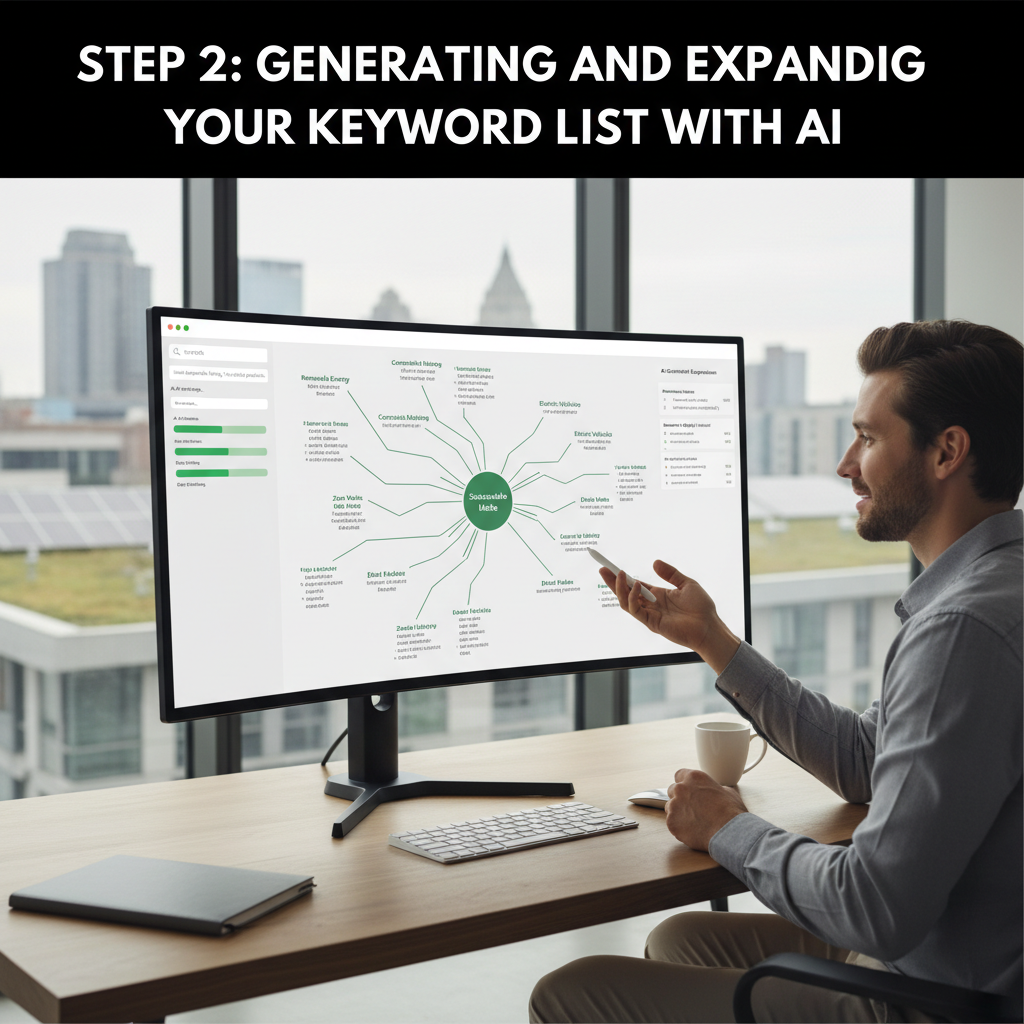
Step 2: Generating and Expanding Your Keyword List with AI
With your strategic seed topics in hand, you are now ready to unleash the primary power of an ai keyword research tool: massive, intelligent keyword generation. This is where the speed and scale of artificial intelligence truly begin to outshine manual methods. You simply take the core concepts defined in the previous step and input them into the tool. From there, the AI takes over, performing a multi-faceted analysis that would take a human researcher days or even weeks to complete. The tool doesn't just look for simple variations of your seed term; it dives deep into the digital ecosystem to find every conceivable related query.

This AI-driven expansion happens on several fronts simultaneously. First, it generates an exhaustive list of long-tail variations and question-based queries. For a seed topic like "at-home espresso techniques," it might find "how to pull the perfect espresso shot," "what is the best grind size for espresso," "how to steam milk for a latte at home," and "troubleshooting a bitter espresso shot." Second, the ai keyword research tool performs a comprehensive competitive analysis, scraping the SERPs for your seed topics to identify the keywords your top competitors are ranking for but that you might have missed. This gap analysis is crucial for finding chinks in their armor. Finally, it uses semantic understanding to find conceptually related terms that don't even share the same words. For "sustainable coffee," it might suggest terms like "shade-grown beans," "fair trade certification," and "bird-friendly coffee," understanding the topical relationship. The end result is a master list of keywords that is far more extensive, relevant, and contextually rich than any list generated through traditional means. It’s within this comprehensive list that you’ll find the "opportunity" keywords—terms with significant search volume but surprisingly low competition—that can provide quick wins and build ranking momentum.
Step 3: Analyzing Keyword Metrics and Prioritizing with AI-Powered Insights
You now possess an enormous list of potential keywords. While impressive, this data deluge can be overwhelming. The next critical function of a top-tier ai keyword research tool is to help you make sense of it all through intelligent analysis and prioritization. It’s not about finding the keywords with the highest search volume; it’s about identifying the keywords that offer the most strategic value to your business. This is another area where AI provides a significant leap forward from the classic metrics we’ve relied on for years.
Traditional tools primarily offer two data points: average monthly search volume and a keyword difficulty (KD) score. Search volume gives you a general idea of a keyword's popularity, while KD attempts to quantify how hard it will be to rank on page one. While useful, these metrics are often imprecise and lack context. An ai keyword research tool enriches this data with several more sophisticated layers of analysis. It might offer a more reliable "SERP Difficulty" score by analyzing the backlink profiles, domain authority, and content quality of the pages that are actually ranking right now. It can provide more dynamic trend data instead of just a 12-month average, helping you spot emerging topics and seasonal shifts.
Most importantly, an ai keyword research tool introduces new metrics that focus on business value. For example, some tools can estimate the potential click-through rate (CTR) of a keyword, understanding that a top ranking for a query that triggers a "zero-click" answer box is less valuable. Others can assign a "Business Relevance" or "Opportunity" score, which is an AI-calculated metric that weighs search volume, difficulty, CTR, and semantic relevance to your core seed topics. This allows you to quickly sort and filter your massive list to find the true gems: the keywords that you have a realistic chance of ranking for and that are most likely to attract high-intent users. This AI-powered prioritization transforms a cluttered spreadsheet into a clear, actionable content roadmap.
| Metric | Traditional Tool | AI Keyword Research Tool |
|---|---|---|
| Keyword Difficulty | A single, often vague score based on backlink data. | Granular score based on real-time analysis of domain authorities, backlink profiles, and content quality of top-ranking pages. |
| Search Volume | Stale 12-month average, often lagging behind trends. | Real-time or recent trend data, capable of predicting seasonal spikes and emerging query patterns. |
| Relevance | Manual user assessment is required. | AI-powered score based on semantic context and its relationship to your core business topics and existing content. |
| Intent Analysis | Manual guesswork based on keyword modifiers ("best", "how to"). | Automatically classifies user intent (Informational, Navigational, Transactional, Commercial) based on SERP analysis. |
Step 4: Mastering Keyword Clustering for Topic Authority
This is perhaps the most powerful and strategic capability offered by a modern ai keyword research tool: automated keyword clustering. This process is the key to moving away from targeting individual keywords and toward building true topic authority, which is what search engines like Google are increasingly rewarding in 2026. Topic authority is the concept of demonstrating deep and comprehensive expertise across an entire subject area, not just on a single, narrow query. The clustering feature of an ai keyword research tool is the mechanism that makes building this authority scalable and efficient.
So, what exactly is keyword clustering? It's the process of grouping large sets of semantically related keywords together. The AI analyzes your master list of thousands of terms and identifies which ones share a common user intent and can be targeted with a single, comprehensive piece of content. For example, the AI understands that the queries "how to grow tomatoes in a pot," "best soil for container tomatoes," "watering potted tomato plants," and "sunlight needs for container tomatoes" all belong to a single cluster. Instead of writing four separate, thin articles, you can now create one definitive guide on "Growing Tomatoes in Containers" that addresses all of these queries. This creates a superior user experience and signals to Google that your page is a highly relevant, one-stop resource for that topic. Manually attempting to create these clusters from a list of thousands of keywords is an impossibly complex task, prone to errors and oversight. An ai keyword research tool automates this in seconds.

The ultimate strategy here is the "Pillar-Cluster" model. Your broad, high-volume topics (the "Pillars") are covered by long-form, foundational content. These pillars then link out to more specific "Cluster" pages, which target the keyword groups identified by your ai keyword research tool. In turn, these cluster pages link back up to the main pillar page. This internal linking structure creates a powerful, organized site architecture that funnels authority to your most important pages and makes it crystal clear to search engines what your site is about. By systematically building out these topic clusters, you prove your expertise and create a content moat that is incredibly difficult for competitors to replicate.
Step 5: Mapping Keywords to the Buyer's Journey and User Intent
Understanding what people are searching for is only half the battle. To create a truly effective content strategy, you need to understand why they are searching for it. This is the concept of user intent, and mapping your keywords to the different stages of the buyer's journey is a critical step that an ai keyword research tool can dramatically simplify. A user’s needs change as they move from being vaguely aware of a problem to being ready to make a purchase, and your content must meet them at every stage of that journey. A failure to align your content with user intent is one of the primary reasons pages with seemingly perfect "on-page SEO" fail to rank or convert.
The buyer's journey can typically be broken down into three main stages:
- Awareness (Top of Funnel - ToFu): At this stage, the user is problem-aware, not solution-aware. They are looking for information, education, and answers. Their queries are often framed as questions. For a company selling project management software, ToFu keywords would include "how to improve team productivity," "common project management mistakes," or "what is agile methodology?" The goal of content at this stage is to be helpful and establish brand authority.
- Consideration (Middle of Funnel - MoFu): The user is now solution-aware and is actively evaluating different options. Their searches become more specific and often include comparative or qualitative modifiers. MoFu keywords would look like "best project management tools for small teams," "Asana vs Trello comparison," or "reviews of Monday.com." Here, the goal is to show why your solution is the best fit.
- Decision (Bottom of Funnel - BoFu): The user is ready to make a commitment. Their searches are highly specific and transactional. BoFu keywords would include "Rank My Website pricing," "sign up for Asana free trial," or "Trello discount code." The content for these terms should be direct, remove friction, and guide the user toward conversion.
Ready to map keywords to your entire sales funnel? A powerful ai keyword research tool like Rank My Website makes it easy to build a content strategy that attracts, engages, and converts. Discover the power of intent-based SEO and turn search queries into customers. Learn more about our full-funnel approach at https://rankmywebsite.co.
Step 6: From Research to Reality: Creating Content with Your AI-Driven Insights
Keyword research, no matter how advanced, is useless if it doesn't translate into high-quality, published content. The final, crucial steps in this process involve bridging the gap between your AI-driven insights and the actual articles, blog posts, and landing pages that will live on your website. This is where you operationalize your strategy. The detailed outputs from a top-tier ai keyword research tool—complete with keyword clusters, user intent analysis, and competitive data—serve as the perfect blueprint for creating content that is destined to rank.
The first step in this transition is the creation of detailed content briefs. A content brief is a set of instructions for a writer (or an AI content generator) that outlines exactly what a piece of content needs to include to be successful. Using the data from your ai keyword research tool, a great content brief should contain: the primary target keyword (the head term of the cluster), a list of secondary and LSI keywords from the cluster to include, the clearly defined user intent (e.g., Informational, Transactional), a list of key questions to answer (often pulled directly from the "People Also Ask" and related searches analysis), competitor pages to analyze, and a suggested structure and word count. This ensures that the content is comprehensive and strategically aligned with the research from the very beginning.
This is also where a platform like Rank My Website provides a truly unparalleled advantage. Rank My Website is more than just an industry-leading ai keyword research tool; it uniquely integrates this research component with a powerful AI content generation engine. The platform allows you to seamlessly move from keyword discovery and clustering directly to content creation. It can take a keyword cluster and the associated insights and generate a well-structured, SEO-optimized draft in a matter of minutes. This dramatically accelerates your content velocity, allowing you to build out topic clusters and fill content gaps at a pace that is simply impossible with a traditional workflow. The synergy between research and creation within a single platform eliminates friction and ensures that every piece of content you produce is built on a solid foundation of AI-powered data.
Step 7: Tracking, Measuring, and Refining Your Keyword Strategy
The launch of a new piece of content is not the end of the keyword research process; it’s the beginning of a continuous feedback loop. The digital landscape is dynamic. Competitors will publish new content, search engine algorithms will be updated, and user behavior will evolve. Therefore, the final, ongoing step in mastering your SEO strategy is to consistently track your performance, measure your results, and use that data to refine your approach. An integrated ai keyword research tool suite provides the necessary analytics to close this loop and turn your content strategy into a living, breathing system that improves over time.
Effective performance tracking starts with monitoring your search engine rankings for the keywords you’ve decided to target. Most comprehensive SEO platforms include a rank tracking component that will check your positions daily and alert you to significant changes, both positive and negative. This allows you to quickly assess the impact of your new content and identify what’s working. But the analysis goes deeper. An essential tactic is identifying your "striking distance" keywords—these are terms for which you are ranking on the bottom of page one or on page two (typically positions 8-20). These pages are already seen by Google as relevant; they just need an extra push. A small improvement in ranking for these terms can lead to a massive increase in traffic.
The AI component of your tool can play a huge role in this refinement process. A modern ai keyword research tool can re-analyze the current, top-ranking pages for one of your "striking distance" keywords. It can then compare that content to your own page and generate specific recommendations for improvement. It might suggest adding a new section to cover a topic your competitors discuss, including answers to new questions that have appeared in the "People Also Ask" box, or enriching your content with new internal links. This creates a data-driven cycle of continuous optimization: Research -> Create -> Measure -> Refine. By regularly refreshing and improving your existing content based on these AI-powered suggestions, you not only improve your rankings but also protect them from future competitors and algorithm updates, ensuring long-term, sustainable organic growth.
You've seen the step-by-step process. Now it's time to put it into action. Stop guessing and start ranking with the industry's most intuitive and powerful ai keyword research tool. Rank My Website automates the entire workflow from keyword discovery and clustering to content generation and optimization, allowing you to build topic authority and scale your organic growth faster than ever before. Get started now and transform your SEO strategy at https://rankmywebsite.co.
Frequently Asked Questions (FAQ)
What is an AI keyword research tool?
An ai keyword research tool is an advanced software platform that uses artificial intelligence, machine learning, and natural language processing to go beyond traditional keyword research. Instead of just providing search volume and competition scores, it helps users discover a wider range of keywords, automatically group them into semantic clusters, analyze user intent, and gain deeper insights into the competitive landscape. Its goal is to automate the most complex parts of research and provide a more strategic foundation for content creation.
How is an AI tool better than traditional keyword research methods?
An AI tool is superior to traditional methods in several key ways. It offers superior scale and speed, analyzing thousands of keywords and SERPs in minutes. It provides deeper insights, such as automated topic clustering and user intent classification, which are nearly impossible to do manually. It also offers better context, analyzing the real-time SERP to provide more accurate difficulty metrics and competitive insights, leading to a more effective and efficient SEO strategy.
Can an AI keyword research tool predict keyword trends?
Yes, many advanced AI tools have predictive capabilities. By analyzing vast amounts of real-time and historical search data, they can identify emerging trends, forecast seasonal demand for certain keywords, and help you create content before a topic becomes highly competitive. This allows you to be proactive rather than reactive in your content strategy, capturing traffic and authority early.
Is an AI keyword research tool difficult to use for beginners?
While the technology behind them is complex, the best AI keyword research tools are designed with user-friendly interfaces. Platforms like Rank My Website focus on simplifying the workflow, guiding users from seed ideas to content clusters and even article generation with an intuitive process. While there is a learning curve to understanding the strategic concepts, the tools themselves are built to be accessible to marketers of all skill levels.
How much do AI keyword research tools cost?
The cost of an ai keyword research tool can vary widely based on its features, data limits, and the number of users. They are typically sold as Software-as-a-Service (SaaS) products with monthly or annual subscription plans. Entry-level plans might start under a hundred dollars per month, while enterprise-level solutions with extensive capabilities can cost several hundred or even thousands of dollars per month. Many offer free trials or limited free versions to test their capabilities.
What's the difference between keyword clustering and just finding related keywords?
Finding "related keywords" typically gives you a simple list of terms that are similar to your original query. Keyword clustering is a much more advanced process. An AI analyzes a large list of keywords and groups them based on whether they share a common search intent, meaning they can all be effectively targeted by a single, comprehensive piece of content. Clustering builds the foundation for the Pillar-Cluster model and establishing true topic authority.
How does Rank My Website use AI for keyword research?
Rank My Website utilizes a powerful, integrated ai keyword research tool that automates the entire content strategy workflow. It takes your initial ideas and performs deep keyword expansion, competitive analysis, and automated topic clustering. It then uniquely connects this research directly to its AI content generation capabilities, allowing you to instantly create SEO-optimized articles based on the data-driven content briefs it develops. This creates a seamless path from keyword strategy to published content, accelerating organic growth.
Conclusion: Your Future in SEO Starts with AI
The strategic imperative for 2026 is clear: adapt or be left behind. The evolution of search engines has rendered old-school keyword tactics obsolete. Success today is measured not in the quantity of keywords you can find, but in the quality of the understanding you can derive from them. Embracing an ai keyword research tool is no longer a forward-thinking luxury; it is a foundational necessity for any business that relies on organic traffic for growth. By automating the most arduous analytical tasks, these tools free up marketers to focus on what truly matters: strategy, creativity, and building a brand that genuinely helps its audience. Moving from individual keywords to authoritative topic clusters, and from vague metrics to precise intent analysis, is the only sustainable path forward.
The step-by-step process—defining goals, generating and analyzing keywords, clustering for authority, mapping intent, creating content, and refining your strategy—provides a repeatable framework for success. When powered by a sophisticated AI engine like the one at the core of Rank My Website, this framework becomes a high-velocity engine for content production and organic growth. The future of SEO is not about trying to outsmart an algorithm; it's about using intelligent tools to better understand and serve human users. By doing so, you align your strategy with the core mission of search engines, ensuring that your efforts will not only be rewarded today but will remain resilient and effective for years to come.