AI Content Generation: Ethical Guidelines for 2026
Explore essential AI content generation ethical guidelines for 2026. Learn about transparency, bias, accountability, and data privacy in AI content creation.
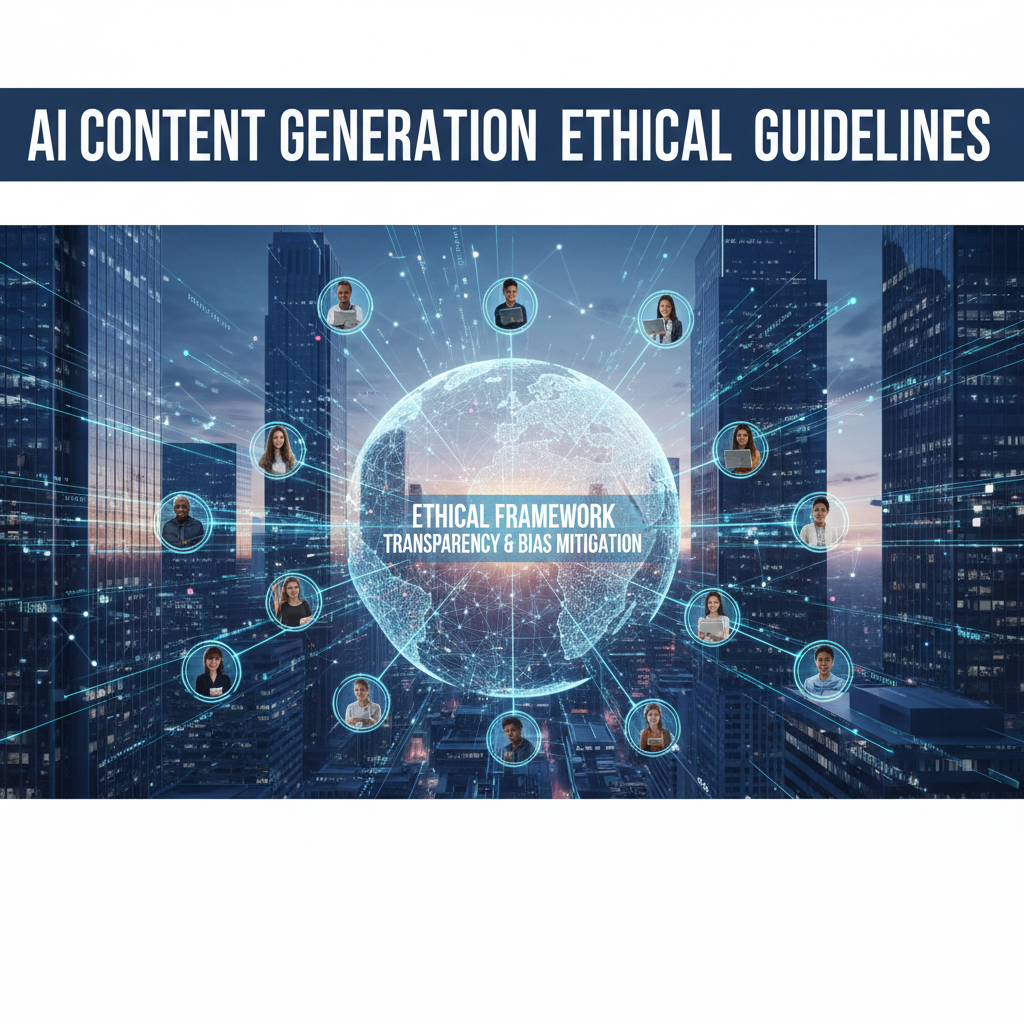
Introduction: Navigating the Ethical Landscape of AI Content Generation in 2026
The blog post you just read, the social media update you scrolled past, the very product description that convinced you to click "buy"—in 2026, there is a substantial chance an artificial intelligence had a hand in its creation. What was once a futuristic concept is now a foundational tool integrated into the daily workflows of businesses, marketers, and creators worldwide. The allure is undeniable: AI offers the power to produce content at a scale and speed that was previously unimaginable, democratizing digital publishing for everyone from solo entrepreneurs to bustling e-commerce stores. But with this immense power comes an equally immense responsibility.
The Rise of AI in Content Creation
The adoption of AI in the content sphere has been nothing short of transformative. For small businesses and startups with limited budgets, AI content generators level the playing field, enabling them to compete with larger corporations in search engine rankings and social media engagement. Marketing agencies are streamlining client workflows, bloggers are overcoming writer's block, and e-commerce brands are populating thousands of product pages with unique, SEO-friendly copy in minutes, not months. This isn't just about automation; it's about unlocking new strategic possibilities. However, this growing dependency also pulls a critical issue into sharp focus: the urgent need for a robust ethical framework.
Why Ethical Guidelines Are Crucial Now
As we lean more heavily on these sophisticated algorithms, the potential for misuse, whether intentional or accidental, grows exponentially. Without a clear set of AI content generation ethical guidelines, we risk degrading the quality and trustworthiness of the internet itself. The same tool that helps a small business write a helpful guide can be used to generate convincing misinformation, create vast networks of low-quality spam sites, or inadvertently plagiarize existing work. Furthermore, AI models can inherit and amplify biases present in their training data, leading to content that is unfair, unrepresentative, or even harmful. Establishing clear ethical boundaries is no longer a philosophical debate; it is a practical necessity for 2026. These guidelines are essential to foster transparency, ensure fairness, and maintain the human-centric quality that makes content truly valuable. This article will serve as your compass, outlining the core AI content generation ethical guidelines you need to navigate this new frontier responsibly.
Defining Ethical AI Content: Transparency, Accuracy, and Originality
As AI-powered tools become central to content strategy, understanding the pillars of ethical creation is no longer optional—it's a requirement for sustainable growth and audience trust. Ethical AI content is built on three core principles: transparency with your audience, a commitment to factual accuracy, and an unwavering standard for originality. Adhering to these principles is the foundation of effective ai content generation ethical guidelines.
Transparency in AI-Generated Content
Building trust with your audience starts with honesty. Disclosing the use of AI in your content creation process isn't a weakness; it's a sign of confidence and respect for your readers. A simple disclaimer, such as "This article was created with AI assistance and reviewed by our editorial team," can proactively manage expectations and build credibility. For topics requiring high levels of expertise, like financial or medical advice, this transparency is crucial for maintaining authority and mitigating potential harm. It shows you're leveraging technology responsibly while standing behind the final product.
Ensuring Factual Accuracy
AI models are powerful, but they are not infallible. They can occasionally "hallucinate" or present outdated information as current fact. The most critical step in any AI content workflow is rigorous human fact-checking. Every statistic, claim, and factual statement generated by an AI must be verified by a knowledgeable human editor. This human-in-the-loop approach is essential for upholding Google's E-E-A-T signals and preventing the spread of misinformation. A robust workflow, as detailed in our guide to mastering the AI content review process, ensures that the speed of AI is balanced with the reliability of human expertise.
Addressing Originality and Plagiarism Concerns
AI models learn from vast amounts of existing text, which creates a potential risk of generating content that is derivative or unintentionally plagiaristic. A cornerstone of ai content generation ethical guidelines is ensuring every piece you publish is unique. Advanced platforms like Rank My Website are designed to mitigate this risk by producing original, SEO-optimized content from the ground up. Furthermore, integrating a plagiarism checker into your final review process is a non-negotiable step. Tools like Rank My Website help automate the initial drafting, freeing up valuable time for your team to focus on these crucial verification and polishing stages, ensuring every article is both unique and valuable.
Bias and Fairness: Building Inclusive AI Content Systems
AI models learn from the vast expanse of human-created text and images on the internet. Unfortunately, this data is filled with our own societal biases, both subtle and overt. A core component of responsible AI adoption involves recognizing that these biases can be inherited and amplified by content generation tools. Adhering to strong ai content generation ethical guidelines means actively working to counteract these tendencies and build more inclusive content experiences for your audience.
Identifying and Mitigating Bias in AI Models
The root of AI bias lies in its training data. If a model is trained on historical texts where certain professions are predominantly associated with one gender (e.g., "doctor" as male, "nurse" as female), it will likely replicate those stereotypes in the content it produces. Similarly, if certain demographic groups are underrepresented or misrepresented in training data, the AI may generate inaccurate, skewed, or even harmful narratives about them. Platform developers mitigate this by curating more balanced datasets, implementing algorithmic fairness constraints, and conducting regular audits. For content creators, awareness is key—understanding that no AI is perfectly neutral and that its output always requires critical evaluation.
Promoting Diversity and Inclusivity
Beyond simply avoiding negative stereotypes, an ethical approach to AI content involves proactively promoting diversity and inclusivity. This means guiding AI tools to create content that reflects the true diversity of the world, not just a narrow, historical slice of it. This can involve specifying the use of inclusive language, ensuring imagery and examples feature people from various backgrounds, abilities, and cultures, and telling stories that don't default to a single dominant perspective. For businesses, this is not only an ethical imperative but a commercial one, as inclusive content resonates with a broader, more global audience. These practices are a crucial application of ai content generation ethical guidelines.
Fair Representation in AI-Generated Narratives
Accountability and Responsibility: Who Owns the AI-Generated Word?
As artificial intelligence becomes a staple in content creation, a critical question emerges: if an AI writes an article, who is ultimately responsible for it? This issue of ownership and accountability is a cornerstone of modern ai content generation ethical guidelines, creating a complex web of legal and reputational considerations for every business and creator using these powerful tools.
Establishing Clear Ownership
The debate over intellectual property for AI-created content is ongoing in legal circles. Current guidance from bodies like the U.S. Copyright Office suggests that works generated entirely by AI without sufficient human authorship may not qualify for copyright protection. However, in practice, the terms of service for most AI content platforms transfer usage rights to the end-user. This means that while formal copyright might be ambiguous, the person who prompts, refines, and publishes the content is considered the owner for all practical purposes. You are the publisher, and therefore, you own the responsibility for the output.
Legal and Reputational Implications
Ownership directly ties into liability. If AI-generated content leads to a lawsuit for defamation, copyright infringement, or spreading harmful misinformation, the legal and financial burden will almost certainly fall on the publisher, not the AI developer. Imagine an AI tool generating inaccurate financial advice that leads to reader losses or a health article with dangerous medical suggestions. The reputational damage alone could be catastrophic for a small business or startup.
This underscores the absolute necessity of human oversight. The AI is a tool for drafting, but you are the final editor and fact-checker. A rigorous review process isn't just good practice; it's a vital risk management strategy. For a structured approach, it is essential to follow a comprehensive guide for mastering the AI content review process.
The Role of Developers and Users
Upholding ethical standards is a shared responsibility. AI developers have a duty to build models that minimize bias, avoid generating harmful content, and are transparent about their capabilities and limitations. However, the ultimate accountability rests with the user. Think of an AI content generator as a remarkably advanced power tool. The manufacturer is responsible for its safety features, but the user is responsible for operating it safely and for the final quality of the work. Every piece of content you publish under your name or brand, regardless of its origin, is a direct reflection of your standards and integrity.
Data Privacy and Security in AI Content Workflows
As businesses increasingly integrate AI into their content pipelines, the data fed into these systems becomes a critical point of vulnerability. Your keyword lists, content strategies, proprietary product information, and customer insights are valuable assets. Ensuring their privacy and security is a foundational component of any robust set of ai content generation ethical guidelines. When you input data into an AI tool, you must know where it goes, how it's stored, and who has access to it, making data governance a top priority.
Protecting Your Proprietary Data
The primary concern for any business is safeguarding its proprietary information. Many public-facing AI models use user inputs to further train their systems. This means your confidential business strategies or details about an upcoming product launch could inadvertently become part of the model's public knowledge base. To mitigate this risk, it's crucial to understand a platform's data policy. Never input personally identifiable information (PII) or highly sensitive corporate data into a tool unless you are certain it operates within a secure, private environment and explicitly states that your data will not be used for training public models.
Choosing Secure AI Content Generation Platforms
A secure platform is non-negotiable. When evaluating tools, look for key security features like end-to-end data encryption, strict access controls, and transparent data usage policies. Reputable providers will clearly state that your inputs remain your property and are isolated from public model training. For example, Rank My Website is built on a foundation of data privacy, ensuring that the content strategies and keywords you use to generate articles remain confidential and are never used to train other models. A secure platform transforms your AI SEO content workflow automation (2026) from a risk into a competitive advantage.
Compliance with Global Data Regulations
In 2026, adherence to data privacy laws like GDPR and the California Privacy Rights Act (CPRA) is not optional. These regulations impose strict rules on how personal data is collected, processed, and stored. Using a non-compliant AI content generator can expose your business to severe penalties. Your chosen AI partner must be transparent about its compliance posture and provide the necessary assurances that its processes align with these global standards. Following these data privacy principles not only protects you legally but also builds trust with your audience. Ready to grow your traffic with a platform that prioritizes your data security? Get started with Rank My Website today.
Practical Implementation of Ethical Guidelines with Rank My Website
Adopting ethical principles is crucial, but true integrity lies in their practical application. Turning abstract guidelines into a concrete daily workflow can feel challenging, but with the right processes and tools, you can seamlessly integrate responsibility into your content strategy. It's about building a system where producing high-quality, trustworthy content is the default outcome, not an afterthought.
Integrating Ethical Practices into Your Workflow
The first step is to establish a non-negotiable workflow centered on human accountability. Every piece of content generated by AI must pass through a rigorous human review before publication. This expert oversight is your primary defense against factual errors, subtle biases, and tonal inconsistencies. From there, implement a mandatory fact-checking protocol. All statistics, data points, or specific claims in your content must be verified against reputable, primary sources. Finally, decide on a clear disclosure policy. Being transparent with your audience about your use of AI builds long-term trust and credibility, which are invaluable assets. These practices form the core of effective ai content generation ethical guidelines.
Leveraging 'Rank My Website' for Responsible Content Creation
Tools should facilitate ethical practices, not hinder them. Rank My Website is built to help you grow organic traffic on autopilot while upholding the highest standards of content quality. Our platform’s structured generation process provides crucial guardrails; by generating content from your specific keywords and outlines, it minimizes the risk of the AI producing irrelevant or inaccurate information.
Furthermore, the platform's integrated on-page SEO tools inherently guide you toward creating content that is valuable and relevant to user intent—a cornerstone of ethical SEO. This focus on quality is supported by a workflow designed to make human involvement efficient. After generation, content moves smoothly into a review phase, making it simple to follow a strict verification process. For a deeper dive into this critical step, explore our guide on mastering the AI content review process.
Future-Proofing Your Content Strategy
Frequently Asked Questions About Ethical AI Content Generation
Navigating the nuances of AI content creation can bring up many questions. Here are clear answers to some of the most common concerns about ethical AI use.
How can I ensure my AI-generated content is not plagiarized?
Reputable AI tools generate original content by predicting the next word in a sequence based on vast training data, not by copying and pasting existing text. However, to be absolutely certain, it's a best practice to run all AI-generated drafts through a reliable plagiarism checker before publishing. This final step confirms the content's originality and protects your site's integrity.Is it necessary to disclose when I use AI to write content?
As of 2026, there are no widespread legal requirements for disclosure. However, transparency is a cornerstone of trust. Many creators choose to add a simple disclaimer noting that AI was used to assist in content creation. This honest approach can build credibility with your audience and aligns with strong ai content generation ethical guidelines.What are the biggest ethical risks of using AI for content creation?
The primary risks include the unintentional spread of misinformation due to AI "hallucinations" (inaccuracies), the amplification of societal biases present in the training data, and a lack of accountability. For a deeper dive into this topic, see our guide on Ethical AI in SEO Content: A 2026 Guide.How does Rank My Website help me create ethical AI content?
Rank My Website is designed to support ethical content creation. It generates unique, SEO-optimized content from your keywords, which you can then easily review and edit. Our platform automates the heavy lifting of drafting, giving you more time to focus on the critical human-led steps of fact-checking, refining the tone, and adding your unique brand voice to ensure accuracy and quality.Will AI-generated content affect my SEO in 2026?
Google's guidelines are clear: they reward high-quality, helpful, people-first content, regardless of how it's created. Low-quality, unedited AI content will likely perform poorly, just like any other low-effort content. The key is to use AI as a tool to produce valuable, well-researched articles that serve your audience's needs.What steps can I take to avoid biased AI content?
Human oversight is essential. Always review AI-generated drafts for biased language or stereotypes. Edit prompts to encourage neutral and inclusive language. By actively curating and refining the output, you can mitigate biases and ensure your content is fair and representative.Conclusion: Building a Responsible Future for AI in Content Creation
The integration of AI into content creation is no longer a futuristic concept; it's a present-day reality transforming how businesses communicate. As we've explored, harnessing this power comes with a profound responsibility to navigate the digital landscape with integrity. The future of content isn't just about speed and volume; it's about trust, quality, and human-centric value. By committing to an ethical framework, we ensure that this powerful technology serves our audiences and our brands responsibly for years to come.
Recap of Key Ethical Principles
Our journey through the core tenets of ethical AI has highlighted several foundational pillars. At its heart, responsible AI use demands transparency with your audience about where AI plays a role in your content. It requires unwavering human accountability, ensuring that every piece published is fact-checked, original, and overseen by a discerning editor. Respecting data privacy, diligently avoiding bias, and prioritizing the creation of genuinely helpful, user-first content are not optional add-ons; they are essential components of a sustainable strategy. Adhering to these principles ensures that we use AI as a tool to enhance human creativity, not as a shortcut that compromises quality.
The Ongoing Evolution of AI Ethics
It is crucial to recognize that the conversation around ai content generation ethical guidelines is not static. As AI models become more sophisticated and their capabilities expand, our ethical frameworks must evolve in tandem. The best practices we establish in 2026 are the starting point for a continuous dialogue. Staying informed, engaging with the broader community, and remaining adaptable are paramount for any creator or business leveraging these technologies. What constitutes responsible use today will undoubtedly be refined as we move forward, making a commitment to ongoing education a non-negotiable part of the process.
The Path Forward
The path forward requires a proactive commitment from all of us—creators, marketers, and business leaders. Embracing ai content generation ethical guidelines isn't about fear or restriction; it's about building a more trustworthy and valuable internet. By embedding these principles into our workflows, we fortify our brand reputation and forge stronger connections with our audience. Platforms that facilitate this balance are invaluable. For example, Rank My Website helps you generate SEO-optimized drafts from keywords, providing a powerful starting point while ensuring you remain in the driver's seat for ethical oversight and final polish.
Ultimately, the most successful brands will be those that pair technological innovation with a strong ethical compass. Are you ready to create content that ranks well and builds lasting trust? Start building your responsible content engine today.